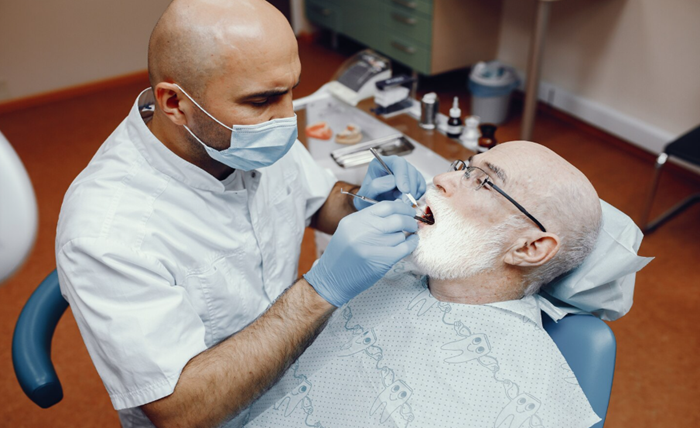
Six anchor points instead of four. That single engineering decision is what separates All-on-6 from the more widely advertised All-on-4 protocol, and it is why a growing share of full-arch patients now specifically ask for it by name. Spreading the load of a complete fixed bridge across six implants rather than four changes how bite forces travel through the jaw, and for patients with reasonable bone volume it is generally the more conservative long-term choice. Antalya has become one of the busiest places in Europe to have this work done, and Dental Harmony Turkey treats All-on-6 as a core discipline rather than an occasional add-on, working primarily with patients arriving from the UK, Germany, the Netherlands and the wider European market.
Six Implants, One Fixed Arch: How the Protocol Works
An All-on-6 case places six titanium posts into a single jaw — commonly a pair toward the front and four spread through the back sections, though the exact map depends on the individual anatomy. More anchor points mean each implant carries a smaller share of the chewing load, so no single fixture becomes a stress concentration point. That matters most for patients who bite hard, patients who clench or grind at night, and anyone who simply wants the longest realistic service life from a full-arch restoration. There is also a practical difference in surgical approach: All-on-4 relies on tilting the rear implants to catch available bone, whereas All-on-6 does not always require that angulation, which in certain anatomies makes placement more direct.
Bone, Bite and Candidacy
- Full or near-full tooth loss in one arch or both
- Bone density in the moderate-to-good range across the jaw
- A preference for extra anchor points rather than the standard four-implant approach
- A heavy bite, or a documented history of bruxism
- Previous bone grafting that has now healed and is ready to receive implants
None of this is settled until the 3D CT is taken on arrival. It is not unusual for a case that looked like a clear All-on-6 on paper to turn out to need All-on-4 once the bone map is in front of the surgeon — and the reverse happens just as often. Imaging comes before any surgical plan is signed off, without exception.
What All-on-6 Costs in 2026: Antalya Against the European Market
| Country / Region | Average Cost | Notes |
| UK | £12,000 – £20,000 | Per arch; private treatment only; London above this range |
| Germany | €10,000 – €17,000 | Not covered by statutory dental insurance |
| Netherlands | €11,000 – €18,000 | Private only; significant demand for Turkish alternatives |
| Antalya, Turkey (Dental Harmony Turkey) | £3,500 – £4,500 | Per arch; includes implants, abutments, temporary and final prosthesis |
Where both jaws need treating, it is worth raising combined-arch options directly with the clinic. Treating upper and lower in the same surgical session usually brings the effective cost per arch down compared with two separate courses of treatment.
Inside the Antalya Package
- A remote first opinion built on X-rays or scan files the patient already holds
- Full 3D CT imaging and treatment planning once in Antalya
- All six fixtures placed in one surgical session wherever the clinical picture allows
- A fixed temporary bridge fitted the same day — nobody goes back to the hotel without teeth
- Written healing guidance plus remote check-ins through the osseointegration window
- A second visit for the permanent zirconia or hybrid bridge, including bite refinement
Choosing Between Four Implants and Six
| Factor | All-on-4 | All-on-6 |
| Implants per arch | 4 | 6 |
| Back implant angulation | Angled to maximise bone | Varies by anatomy |
| Bone volume required | Lower — can work with less | Moderate — more even distribution |
| Grafting likelihood | Often avoidable | Usually not required with adequate bone |
| Bite load distribution | Good | Superior |
| DHT price per arch | £3,000 – £3,500 | £3,500 – £4,500 |
This decision belongs to the surgeon, not the sales conversation. Dental Harmony Turkey’s implantology team settles it against the CT data taken on arrival, and the price difference between the two protocols plays no part in that judgement.
From First Email to Final Bridge
- Remote phase — Existing X-rays or CT files are reviewed and a provisional plan drafted before any flight is booked.
- Arrival and imaging — Full 3D CT taken, plan finalised, any remaining extractions completed.
- Surgery day — Six implants placed under local anaesthetic, with the temporary bridge fitted in the same appointment.
- Recovery at home — The patient flies home wearing fixed temporary teeth while osseointegration runs its 3–6 month course, supported by remote check-ins.
- Return visit — The permanent restoration is designed, manufactured, fitted and adjusted to the bite.
The Case for Antalya
Antalya’s advantage is partly geographic and partly statistical. Direct routes from most large UK and European airports remove the connecting-flight problem, and the city’s dental sector has been serving international patients long enough that the logistics — transfers, translation, coordination between surgery and laboratory — are handled as routine rather than improvised. High annual case volume also matters clinically: surgical teams here place full-arch implants week in, week out. As one of the established Antalya Dental Clinic options for overseas patients, Dental Harmony Turkey keeps English-language coordination running through the whole process and builds its packages around the specific realities of travelling for treatment.
Questions Patients Ask Most
How long does the surgery take? Expect 2–3 hours per arch under local anaesthetic for the placement itself, with the temporary prosthesis fitted in the same session.
Is the procedure painful? The surgery is carried out under local anaesthetic, so discomfort during placement is minimal. Swelling and soreness for 3–5 days afterwards is expected and responds to standard pain relief.
What is the temporary prosthesis like? It is fixed rather than removable, and it supports normal speech and a soft diet from the first day. It stays in place for the whole healing period.
What is the permanent restoration made from? Usually full-arch zirconia, or a zirconia-acrylic hybrid, with the choice made at the design appointment based on patient preference and clinical factors.
Final Thoughts
All-on-6 in Antalya has settled into something predictable in 2026: an established protocol, transparent per-arch pricing, and a two-visit structure designed around people who are flying in rather than driving across town. Against UK and German figures, the saving per arch is not marginal. For the full protocol and current pricing, see the antalya all on 6 page on the Dental Harmony Turkey website.